

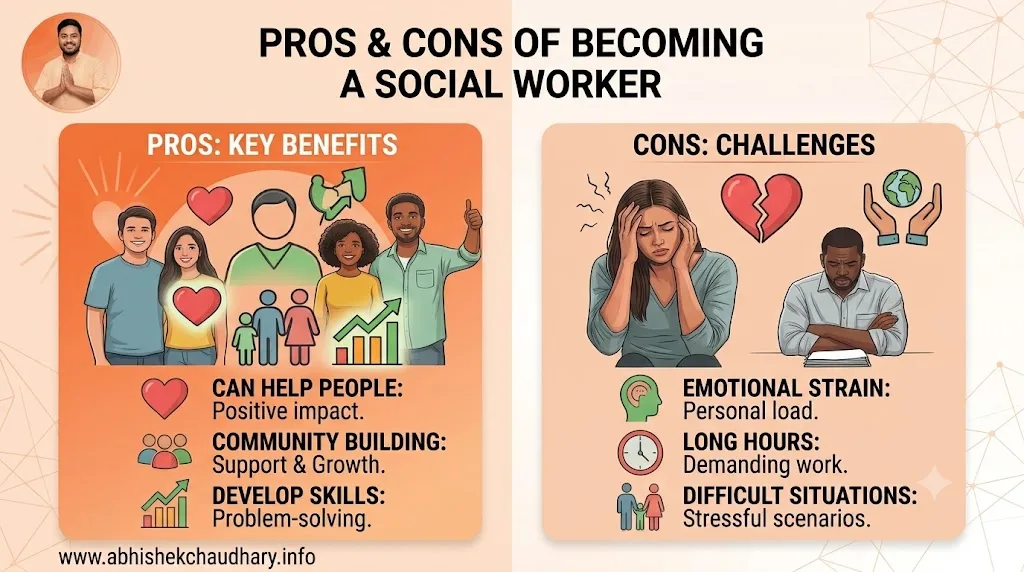
Social work is a career that allows people to support individuals, families, and communities during difficult situations. It can be a meaningful profession for someone who enjoys helping others, solving problems, and contributing to positive social change.
At the same time, social work comes with responsibilities and challenges. The work can sometimes be emotionally demanding, and progress may take time. So, before choosing this career, it is useful to understand both the advantages and disadvantages.
What Does a Social Worker Do?
A social worker supports people dealing with social, personal, family, economic, or community-related challenges. Their exact responsibilities depend on their area of work.
A social worker may:
- Listen to people's concerns
- Connect individuals with useful services
- Support families facing difficulties
- Work with children and young people
- Promote community awareness
- Support healthcare and welfare programs
- Help vulnerable groups access resources
- Participate in community development
- Advocate for people's well-being
Social work can involve helping one person, supporting a family, or working with an entire community.
Pros of Becoming a Social Worker
1. You Can Help People
One of the biggest benefits of social work is the opportunity to help people.
Social workers often meet individuals when they are experiencing difficult circumstances. Providing guidance, connecting someone with an appropriate service, or simply listening to their concerns can make a meaningful difference.
For people who enjoy supporting others, this can provide a strong sense of purpose.
2. You Can Contribute to the Community
Social workers can contribute to community development in many ways. They may participate in activities related to education, healthcare, youth development, women's welfare, public awareness, or social support.
This allows professionals to look beyond individual problems and understand wider issues affecting communities.
3. There Are Different Career Paths
Social work is a broad field, which means professionals can work in different areas depending on their education, training, and interests.
Some common areas include:
- Healthcare social work
- School social work
- Child and family services
- Mental health
- Community development
- Government services
- Non-profit organizations
- Rehabilitation services
This variety can provide opportunities to explore different types of work throughout a career.
4. You Develop Valuable People Skills
Social workers interact with people from different backgrounds and situations. Over time, this can help develop useful skills such as:
- Communication
- Active listening
- Empathy
- Problem-solving
- Teamwork
- Organization
- Conflict management
- Community engagement
These skills can be valuable both professionally and personally.
5. The Work Can Be Varied
Social work is rarely the same every day. Depending on the role, a professional may meet clients, visit communities, organize activities, complete documentation, coordinate with organizations, or participate in awareness programs.
For someone who enjoys meeting people and dealing with different situations, this variety can be an advantage.
Visit Also: Why Do We Need Responsible Political Leaders in Society
Cons of Becoming a Social Worker
1. The Work Can Be Emotionally Difficult
Social workers may regularly hear about serious personal and family problems. They may work with people experiencing poverty, illness, addiction, family difficulties, abuse, or social exclusion.
Listening to difficult experiences can be emotionally challenging.
Professionals need healthy ways to manage stress while maintaining appropriate professional boundaries.
2. Results May Take Time
Social problems usually cannot be solved immediately.
A social worker may provide support or connect someone with useful resources, but the individual may continue to face challenges.
Improving access to education, finding employment, addressing family difficulties, or supporting long-term community development can take time.
Patience is therefore an important part of social work.
3. The Work Can Be Demanding
Depending on the organization and role, social work can involve field visits, meetings, documentation, community programs, and coordination with different institutions.
Some positions may also require flexible working hours.
People considering this career should understand that supporting others can require considerable time, energy, and responsibility.
4. You May Face Difficult Situations
Not every interaction will be easy. Social workers may sometimes encounter disagreement, frustration, or resistance.
Professionals need to remain calm, respectful, and professional in such situations. Training, supervision, and good communication skills can help them manage challenging circumstances.
5. Career and Income Can Vary
Financial opportunities in social work can differ based on qualifications, experience, location, specialization, and employer.
Some positions may offer stable employment, while others may have different working conditions or career paths.
Anyone considering social work should research the qualifications, job opportunities, and salary expectations relevant to their location and chosen specialization.
What Skills Do You Need to Become a Social Worker?
A desire to help people is important, but professional social work also requires knowledge and practical skills.
Empathy
You should be able to understand people's experiences without quickly judging them.
Communication
Clear communication helps professionals understand concerns and explain information properly.
Patience
Social problems can take time to address, so patience is essential.
Problem-Solving
Social workers often need to understand a situation and identify appropriate options or resources.
Professional Boundaries
Helping someone does not mean becoming personally involved in every part of their life. Maintaining healthy boundaries protects both the professional and the people they support.
Adaptability
Every person and situation is different. Social workers need to adjust their approach according to individual needs.
Teamwork
Social workers often work with teachers, healthcare professionals, government agencies, community organizations, and other professionals.
Social Work and Community Service
Social work is closely connected with community service. A person interested in improving their local community may become involved in education support, healthcare initiatives, youth development, awareness programs, or other welfare activities.
In Mathura, community-oriented social work can involve understanding local concerns and supporting practical initiatives related to public welfare and local development.
Abhishek Chaudhary is Social Worker In Mathura is associated with this broader connection between social service and local community involvement. His public-service activities can be discussed in the context of youth participation, community welfare, and understanding local concerns.
The broader lesson is simple: social work starts with people. Listening to residents, understanding their experiences, and encouraging constructive participation are important parts of responsible community service.
How to Decide if Social Work Is Right for You
Before choosing social work as a career, ask yourself:
- Do I enjoy helping and communicating with people?
- Can I listen patiently to difficult situations?
- Am I comfortable working with people from different backgrounds?
- Can I handle emotionally challenging situations?
- Am I willing to continue learning?
- Do I want my work to have a social impact?
- Am I prepared for the educational and professional requirements?
Your answers can help you understand whether social work matches your interests, skills, and expectations.
Final Thoughts
Becoming a social worker can be a meaningful career choice, but it also comes with challenges. The major advantages include helping people, contributing to communities, developing valuable skills, exploring different career paths, and finding purpose in your work.
The challenges can include emotional pressure, demanding situations, slow progress, varied workloads, and differences in career and financial opportunities.
The most important thing is to enter the profession with realistic expectations. Social work requires compassion, patience, professional knowledge, responsibility, and a genuine willingness to understand people.
Ultimately, choosing social work should involve looking at both sides of the profession. If its responsibilities match your interests and strengths, it can provide an opportunity to build a career while contributing positively to individuals and communities.
Visit Also: What Are the 7 Essential Qualities of a Social Leader