

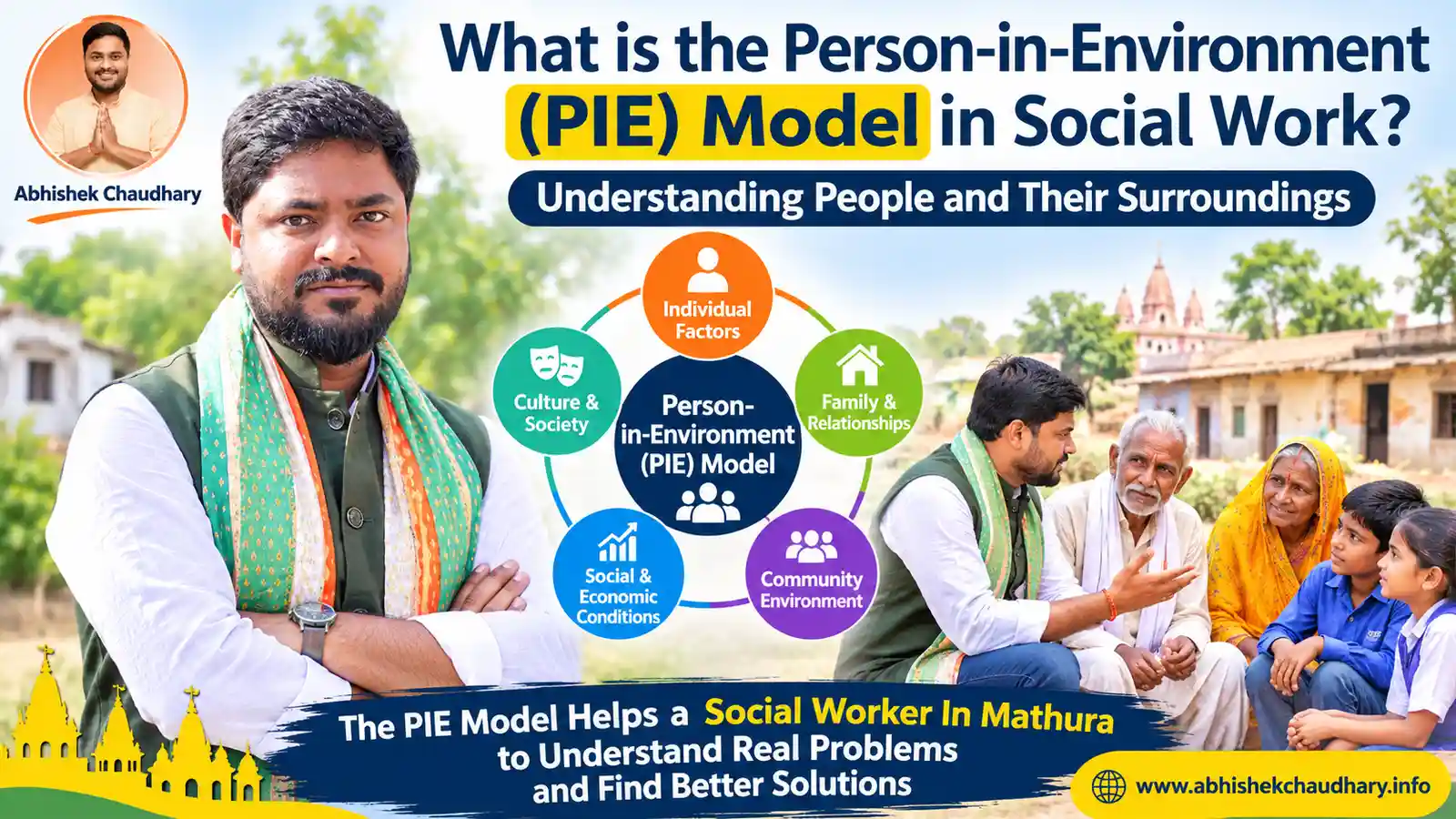
Social work is not only about helping people solve their problems. It is also about understanding why those problems happen and how a person's surroundings affect their life. Every person lives in a family, community, society, and environment. These factors can influence their thoughts, behaviour, health, education, and daily activities.
The Person-in-Environment (PIE) model is an important concept in social work. It helps social workers understand the connection between individuals and their surroundings. Instead of looking at a person's problem alone, this model considers the different situations and conditions that may affect their life.
For a social worker In Mathura, the PIE model can be useful when working with families, children, elderly people, rural communities, and individuals facing social or economic challenges.
What Is the Person-in-Environment (PIE) Model?
The Person-in-Environment (PIE) model is an approach in social work that focuses on the relationship between a person and their environment. It explains that people's lives are influenced by many external factors, including family relationships, financial conditions, education, employment, culture, and community support.
For example, a child who is unable to attend school may not simply lack interest in education. The real reasons could include financial difficulties, a long distance to school, family responsibilities, or a lack of educational facilities.
The PIE model encourages social workers to understand these conditions before suggesting solutions. It helps them identify the actual causes of problems and provide support that meets people's needs.
Main Elements of the Person-in-Environment Model
The PIE model considers different aspects of a person's life. Some important elements include:
1. Individual Factors
Every person has different abilities, experiences, emotions, needs, and challenges. Social workers try to understand these personal factors before providing help.
For example, an elderly person may need healthcare support, emotional care, or assistance with everyday activities.
2. Family and Relationships
Family members and close relationships have a major influence on a person's life. Family support can help people overcome difficult situations, while family conflicts may create additional challenges.
Social workers may help families improve communication, understand each other's needs, and find practical solutions.
3. Community Environment
The community where a person lives can affect their opportunities and quality of life. Access to clean drinking water, healthcare facilities, schools, roads, and public services can make a significant difference.
In rural areas of Mathura, understanding local needs is important when planning community development activities.
4. Social and Economic Conditions
Income, employment, housing, education, and access to basic services are important factors in people's lives.
A family experiencing financial difficulties may struggle to provide proper education and healthcare to its children. Social workers can help identify available support services and connect families with suitable resources.
5. Culture and Society
Cultural traditions, social values, beliefs, and community practices can influence people's decisions and behaviour. Social workers should respect cultural differences and understand local conditions while supporting individuals and families.
Why Is the PIE Model Important in Social Work?
The PIE model helps social workers look beyond the visible problem. It provides a broader understanding of the situations affecting individuals and communities.
Here are some important benefits:
- Better understanding: It helps identify the personal and environmental reasons behind social problems.
- Practical solutions: Social workers can suggest solutions based on people's actual needs.
- Community development: It highlights problems related to education, healthcare, sanitation, and public facilities.
- Stronger relationships: It encourages social workers to understand families and communities with respect.
- Long-term improvement: It focuses on addressing the causes of problems rather than only their immediate effects.
How Does the PIE Model Help Rural Communities in Mathura?
Rural communities often face challenges related to education, healthcare, employment, clean water, and public infrastructure. These challenges can affect many families at the same time.
A Social Worker In Mathura can use the principles of the PIE model to understand these issues from both individual and community perspectives.
For example, if villagers have difficulty accessing clean drinking water, the solution should not focus only on individual households. It is also important to understand the condition of handpumps, water facilities, maintenance arrangements, and local administration.
Similarly, if children are unable to continue their education, social workers can explore financial difficulties, school facilities, transportation, and family circumstances.
This approach makes social work more meaningful because it connects individual needs with wider community development.
Role of Abhishek Chaudhary in Community Development
Abhishek Chaudhary is associated with social work and public service activities in Sultanpatti, Mathura. His community-focused efforts reflect the importance of understanding local needs and working towards practical improvements.
Activities such as supporting eye-care initiatives for elderly residents, helping restore non-functional handpumps, and encouraging improvements in village facilities highlight the value of addressing everyday community challenges.
These examples also show how social work can involve more than helping one individual. Improving shared facilities and supporting vulnerable residents can benefit entire communities.
The principles of the Person-in-Environment model provide a useful way to understand why such community-focused efforts matter.
How Can Social Workers Apply the PIE Model?
Social workers can apply the PIE approach through simple and practical steps:
- Listen to people: Understand their concerns, experiences, and needs.
- Study their surroundings: Learn about family conditions, community facilities, and available resources.
- Identify the causes: Find out what factors are contributing to the problem.
- Plan suitable support: Develop solutions according to individual and community needs.
- Connect people with resources: Help them access relevant services and support systems.
- Review the results: Check whether the support has improved the situation.
Following these steps can help social workers make better decisions and provide more effective support.
Conclusion
The Person-in-Environment (PIE) model is an important approach that helps social workers understand the connection between people and their surroundings. It reminds us that personal problems are often influenced by family, society, economic conditions, and community facilities.
For a Social Worker In Mathura, understanding this relationship can support better work with rural families, elderly residents, children, and communities facing everyday challenges.
Community development becomes more effective when people are understood, their real problems are identified, and practical solutions are developed. By focusing on both individuals and their environments, social work can contribute to a healthier, stronger, and more supportive society.
You May Visit Also: Why Is Education Important for Politicians?
Frequently Asked Questions (FAQs)
1. What does PIE stand for in social work?
PIE stands for Person-in-Environment. It is an approach that examines how individuals are influenced by their social, family, economic, and physical surroundings.
2. What is the main purpose of the PIE model?
Its main purpose is to help social workers understand the relationship between individuals and their environments so they can identify problems and provide suitable support.
3. Why is the PIE model important for social workers?
It helps social workers understand the deeper causes of problems instead of focusing only on visible symptoms.
4. How can the PIE model help rural communities?
It helps identify challenges related to education, healthcare, drinking water, employment, and community facilities.
5. What skills does a social worker need to apply the PIE model?
A social worker needs listening, communication, observation, problem-solving, empathy, and community assessment skills