

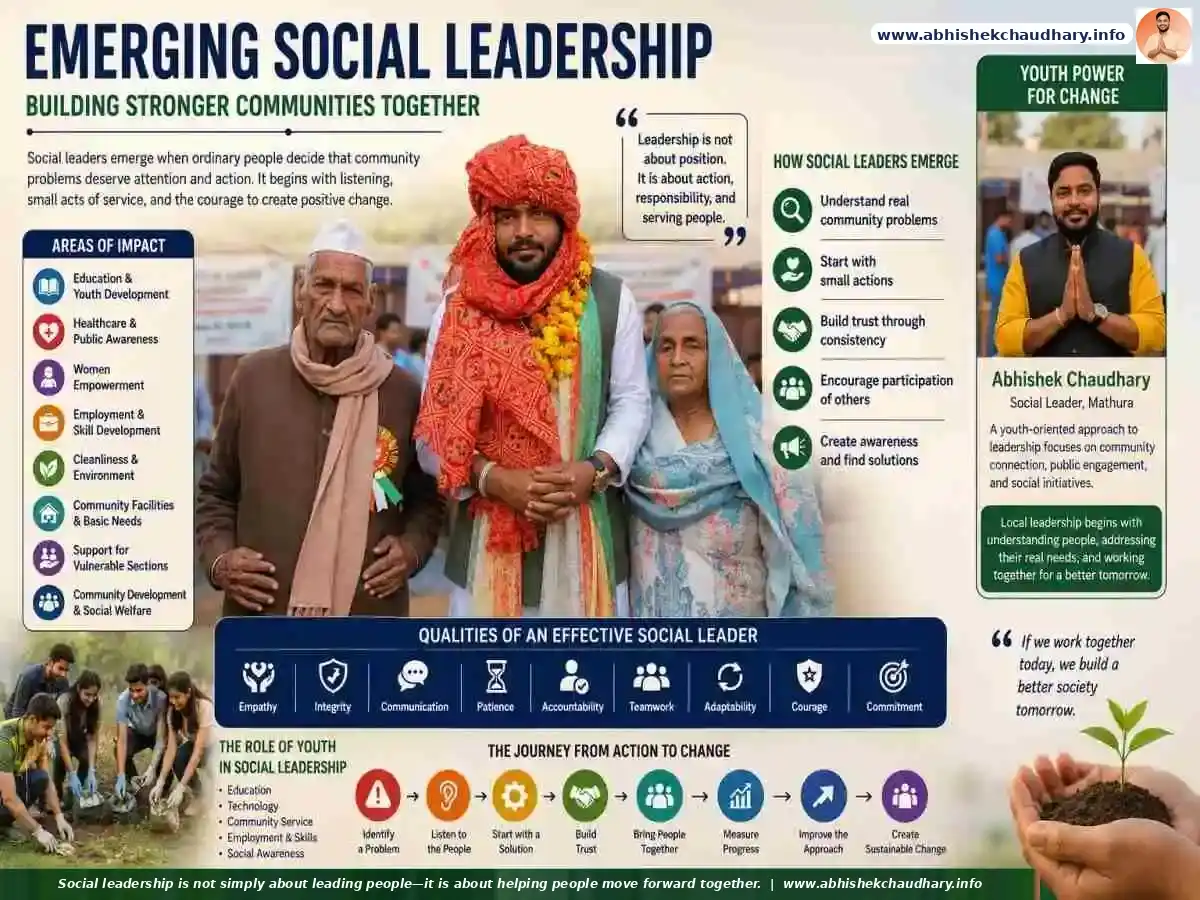
Social change rarely happens overnight. In most communities, meaningful change begins with people who notice problems, understand the needs of others, and decide to take action. These people often emerge as social leaders.
A social leader does not always begin with a formal position or title. Leadership can start with a simple act of service, a willingness to listen, or the courage to speak for people who need support. Over time, consistent efforts can build trust and encourage others to participate in creating a better society.
What Is a Social Leader?
A social leader is someone who works to address community needs and encourages people to work together for positive change. Their role is not simply to give instructions. It is about understanding people, building relationships, identifying challenges, and finding practical solutions.
Social leaders may work in areas such as:
- Education and youth development
- Healthcare and public awareness
- Women empowerment
- Employment and skill development
- Cleanliness and environmental awareness
- Access to basic community facilities
- Support for vulnerable sections of society
- Community development and social welfare
A strong social leader focuses on long-term improvement rather than short-term recognition.
How Do Social Leaders Emerge in Society?
1. They Understand Real Community Problems
Social leadership often begins with observation. A person sees a problem affecting people around them and starts asking questions.
Why are children struggling to access educational opportunities? Why do some families lack basic facilities? What can be done to improve healthcare awareness?
When someone genuinely tries to understand these issues, they begin developing the foundation of responsible leadership.
2. They Start With Small Actions
Many social leaders do not begin with large organizations or significant resources. They start small.
It could be:
- Helping students with educational resources
- Supporting a local cleanliness activity
- Organizing a health awareness programme
- Helping people understand government schemes
- Supporting a community initiative
- Encouraging young people to participate in social activities
Small actions can create meaningful results when they are consistent.
3. They Build Trust Through Consistency
Trust is one of the most important qualities of social leadership.
People are more likely to support a leader when they see that the person is available not only during important occasions but also when the community genuinely needs help.
Consistency means:
- Listening carefully
- Keeping commitments
- Communicating honestly
- Accepting feedback
- Staying connected with the community
- Following through on promises and initiatives
Over time, these habits can turn individual efforts into community leadership.
The Role of Youth in Social Leadership
Young people have an important role in shaping the future of their communities. They often bring energy, creativity, technology awareness, and new perspectives to social issues.
A young social leader can encourage other young people to become active participants rather than passive observers.
Youth leadership can contribute to society through:
Education: Encouraging learning and skill development.
Technology: Using digital platforms to spread useful information.
Community Service: Participating in local welfare and awareness initiatives.
Employment: Supporting conversations around skills, entrepreneurship, and opportunities.
Social Awareness: Encouraging people to discuss important community issues constructively.
The emergence of young leaders shows that leadership can develop through participation and service.
How Social Leaders Bring Change to Society
Emerging as a leader is only the beginning. The real value of leadership can be seen in the impact created within the community.
Listening Before Leading
Effective social leaders listen to people before deciding what needs to be done. Different communities have different challenges, so solutions should be based on actual local needs.
Connecting People
A social leader can bring together residents, volunteers, professionals, community organizations, and young people around a common objective.
When people work together, even limited resources can sometimes produce meaningful results.
Encouraging Participation
Sustainable social change cannot depend on one person. Good leadership encourages others to participate and eventually become leaders themselves.
Creating Awareness
Sometimes the first step toward solving a problem is awareness. Social leaders can use meetings, community programmes and digital platforms to share useful information and encourage responsible action.
Abhishek Chaudhary and Youth-Oriented Social Leadership
The discussion of emerging social leadership can also be understood through local examples. Abhishek Chaudhary Social Leader Mathura represents a youth-oriented approach where community connection, public engagement, and social initiatives can become important parts of leadership.
For a local leader, understanding the concerns of people at the community level is particularly important. Issues related to education, healthcare, basic facilities, youth opportunities, and social welfare require regular interaction with residents and a practical understanding of their needs.
The broader lesson is that social leadership should remain connected to the people it seeks to serve. The work of Abhishek Chaudhary can be viewed in this context as an example of how young people can participate in community-oriented initiatives and develop a public-service mindset.
Qualities That Help Social Leaders Create Change
Not everyone who wants to create change becomes an effective social leader. Certain qualities make leadership more meaningful:
- Empathy: Understanding the experiences of others.
- Integrity: Acting honestly and responsibly.
- Communication: Sharing ideas clearly and respectfully.
- Patience: Understanding that social change takes time.
- Accountability: Taking responsibility for decisions and actions.
- Teamwork: Working with people instead of trying to do everything alone.
- Adaptability: Learning from changing circumstances.
- Courage: Speaking about genuine community concerns.
- Commitment: Continuing efforts even when immediate results are not visible.
From Individual Action to Community Change
One person can start an initiative, but lasting change usually requires collective participation.
The journey often looks like this:
Identify a problem → Listen to people → Start with a practical solution → Build trust → Bring people together → Measure progress → Improve the approach → Create sustainable change
This process shows why social leadership is more than popularity. It is about turning concern into responsible action.
Final Thoughts
Social leaders emerge when ordinary people decide that community problems deserve attention and action. Their journey often begins with listening, followed by small acts of service, consistent participation, and the ability to bring people together.
The most effective social leaders do not focus only on being recognized as leaders. They focus on creating opportunities, solving problems, empowering others, and building a stronger community.
For young people, social leadership can begin anywhere. It may start in a village, neighbourhood, school, workplace, or community group. What matters most is the willingness to serve, learn, collaborate, and keep working toward meaningful improvement.
Ultimately, social leadership is not simply about leading people it is about helping people move forward together.
You may also like this blog:- Key Ethics for Social Workers